

How many lumens per m²? The quick guide
Too dark, and you squint. Too bright, and it feels like an office. Here is the simple way to judge the right amount of light for a room, without complicated maths.
Lumens, not watts
For years we chose bulbs ‘by the watt’. With LED, wattage no longer tells you anything about the light produced: what counts is the lumen (lm), the amount of light emitted. More lumens = more brightness.
The rule: area × target lux
Every room has a lighting requirement, expressed in lux (lumens per m²). The formula fits on a single line:
Lumens needed = area (m²) × recommended lux
Room-by-room guidelines
- Living room: 100 to 150 lux (ambient), up to 300 for a reading nook
- Bedroom: 100 to 150 lux, soft light
- Kitchen: 250 to 300 lux (more on the worktop)
- Bathroom: 200 to 300 lux, especially around the mirror
- Study: 300 to 500 lux to work without eye strain
- Hallway / entrance hall: 100 lux is enough
A real-life example
A 20 m² living room with a target of 150 lux: 20 × 150 = 3000 lumens in total. Spread them across a ceiling light, a floor lamp and an accent lamp — never a single source.
The secret: layer your sources
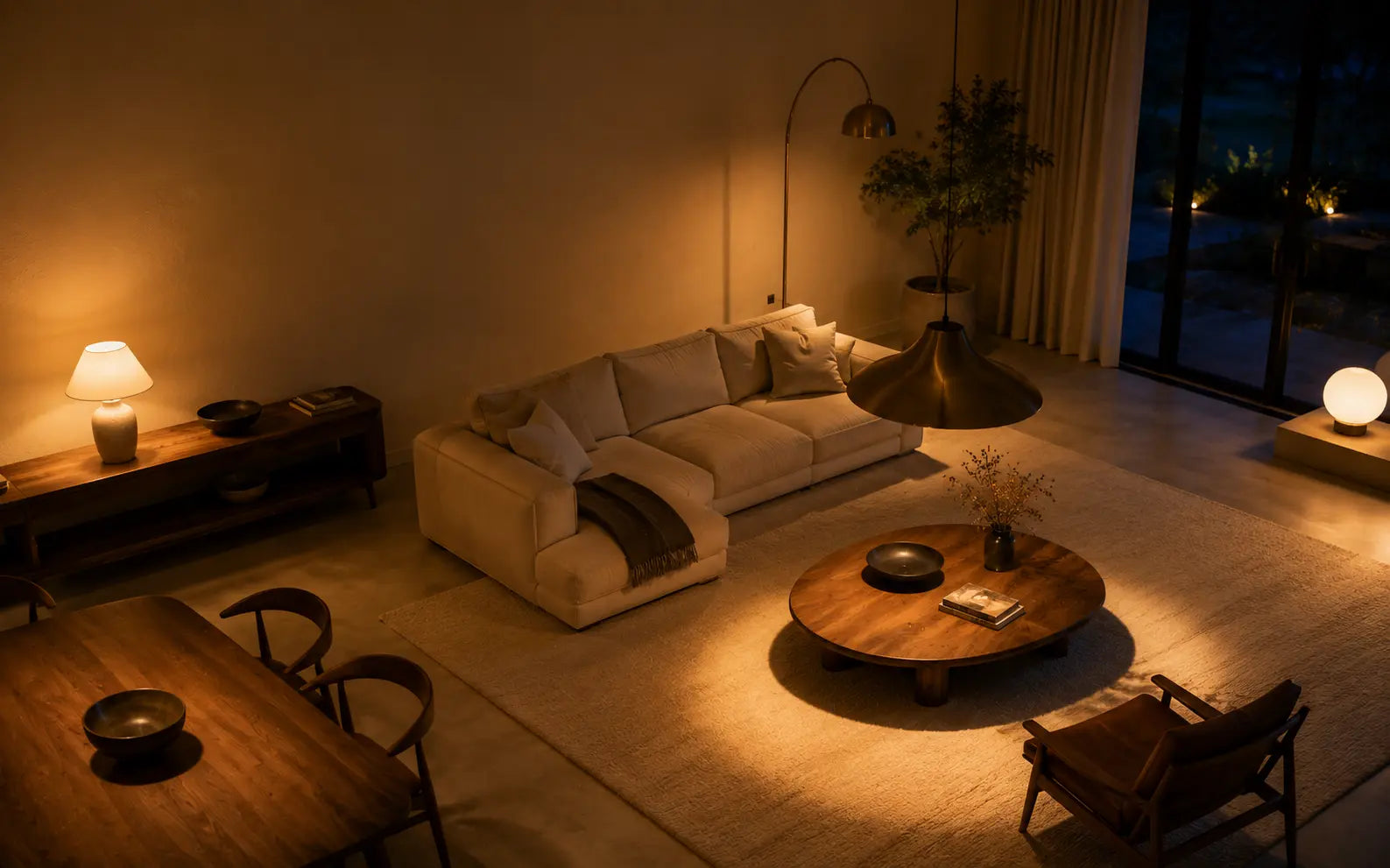
Beautiful light does not come from one large fitting, but from three layers: general light (ceiling light), task light (desk lamp, wall light) and ambient light (table lamp, dimmer). That is what gives a room depth and comfort in the evening.

The Lumsky team
Lumsky — Exceptional lighting


